Organoid intelligence (OI) is an emerging field of study in computer science and biology that develops and studies biological wetware computing using 3D cultures of human brain cells (or brain organoids) and brain-machine interface technologies. Such technologies may be referred to as OIs or the nervous filesystem. Organoid intelligent computer systems can be an example of biohybrid systems. == Differences with non-organic computing == As opposed to traditional non-organic silicon-based approaches, OI seeks to use lab-grown cerebral organoids to serve as "biological hardware". While these structures are still far from being able to think like a regular human brain and do not yet possess strong computing capabilities, OI research currently offers the potential to improve the understanding of brain development, learning and memory, potentially finding treatments for neurological disorders such as dementia. Thomas Hartung, a professor from Johns Hopkins University, argued in 2023 that "while silicon-based computers are certainly better with numbers, brains are better at learning." He noted that transistor density in computer chip may be approaching its limits, whereas brains, being wired differently, are more energy-efficient and can store large amounts of information. Some researchers claim that even though human brains are slower than machines at processing simple information, they are far better at processing complex information as brains can deal with fewer and more uncertain data, perform both sequential and parallel processing, being highly heterogenous, use incomplete datasets, and is said to outperform non-organic machines in decision-making. Training OIs involve the process of biological learning (BL) as opposed to machine learning (ML) for AIs. == Bioinformatics in OI == OI generates complex biological data, necessitating sophisticated methods for processing and analysis. Bioinformatics provides the tools and techniques to decipher raw data, uncovering the patterns and insights. Researchers have developed a platform named Neuroplatform for experimenting remotely with brain organoids via an API. == Intended functions == Brain-inspired computing hardware aims to emulate the structure and working principles of the brain and could be used to address current limitations in AI technologies. However, brain-inspired silicon chips are still limited in their ability to fully mimic brain function, as most examples are built on digital electronic principles. One study performed OI computation (which they termed Brainoware) by sending and receiving information from the brain organoid using a high-density multielectrode array. By applying spatiotemporal electrical stimulation, nonlinear dynamics, and fading memory properties, as well as unsupervised learning from training data by reshaping the organoid functional connectivity, the study showed the potential of this technology by using it for speech recognition and nonlinear equation prediction in a reservoir computing framework. == Ethical concerns == While researchers are hoping to use OI and biological computing to complement traditional silicon-based computing, there are also questions about the ethics of such an approach. Concerns include the possibility that an organoid could develop sentience or consciousness, and the question of the relationship between a stem cell donor (for growing the organoid) and the respective OI system.
Triller (app)
Triller is an American video-sharing social networking service that was first released for iOS and Android in 2015. The service allowed users to create and share short-form videos, including videos set to, or automatically synchronized to, music using artificial intelligence technology. It initially operated as a video editing app before adding social networking features. Triller gained prominence in 2020 as a competitor to the similar Chinese-owned app TikTok, mainly in the United States and India (after the service was banned in the latter country). The app's success would allow its parent company to expand into sports broadcasting and promotion; including the distribution of pay-per-view boxing events under the Triller Fight Club banner (such as Mike Tyson vs. Roy Jones Jr. and Jake Paul vs. Ben Askren) that incorporated live music performances and appearances by various celebrities and entertainment personalities. == History == === Launch and early years === Triller was launched in 2015 by co-founders David Leiberman and Sammy Rubin. The app was originally positioned as a video editor, using artificial intelligence to automatically edit distinct clips into music videos. They later launched Triller Famous, a page within the app that featured curated selections of user videos. In 2016, the app was purchased by Carnegie Technologies and converted into a social networking service by allowing users to follow each other and share their videos publicly. In 2019, Ryan Kavanaugh's Proxima Media made a majority investment. It is headquartered in Los Angeles, California, and is currently led by CEO Mahi de Silva. === Media exposure and controversies === On June 29, 2020, Government of India banned TikTok, among other apps stating that they were "prejudicial to [the] sovereignty and integrity" of India. Triller, which had planned to enter into the Indian market by the end of 2020, saw a spike from less than 1 million users to over 30 million users in the country overnight. In July 2020, Triller sued ByteDance, the Chinese parent company of TikTok, for infringing patents relating to video editing. In response, TikTok and ByteDance filed a lawsuit against Triller, alleging the litigation initiated by Triller has "cast a cloud" over TikTok's reputation and business dealings. That Summer, U.S. president Donald Trump signed an executive order which threatened to ban TikTok from operating within the United States, citing threats to national security, unless it was sold by ByteDance. The Trump administration stated that TikTok had until November 12, 2020, to assure the administration that the app did not pose any national security threats to the U.S. Following this order and news of possible purchases of TikTok's American operations by companies such as Oracle, Triller jumped from number 198 to number one in the App Store in the U.S., while TikTok dropped down to number three. The discussions surrounding TikTok's potential ban in the United States caused popular TikTok stars, including Charli D’Amelio and her family, to join Triller. Trump joined Triller himself and posted his first video on August 15, 2020. The video received over a million views within hours. On August 12, 2020, Triller partnered with B2B music company 7digital, which will provide Triller with access to its catalogue of 80 million tracks and automatically report usage data to Sony Music, Warner Music Group, Universal Music Group and Merlin Network. The number of Triller's app installations came under scrutiny when third-party analytics firm Apptopia estimated only 52 million lifetime installations of the app by August 2020, while Triller claimed 250 million. Triller threatened to sue Apptopia for publishing the report. By October 2020, Triller claimed to serve 100 million active monthly users, but this number was quickly disputed by six former employees interviewed by Business Insider. Within a few weeks of Triller's claim, employees shared screenshots of the company's internal analytics that showed less than 2.5 million active monthly users. On October 2, 2020, Triller signed licensing deals with the rights societies PRS for Music, GEMA, STIM and IMRO, and the publishers Concord, Downtown and Peermusic. On February 5, 2021, Universal Music Group (UMG) pulled its library from Triller, citing unpaid music royalties. They alleged that Triller "shamefully withheld payments owed to our artists" and refused to negotiate future music licensing. Triller responded with the assertion that "relevant artists" were already partnered with Triller, so a deal with UMG was unnecessary. The two companies reached an expanded licensing agreement in May 2021. On March 24, 2021, Triller signed a licensing agreement with the National Music Publishers' Association. == Features == The Triller app allows users to create music videos, skits, and lip-sync videos containing background music. The app's spotlight feature is its special auto-editing tool, which uses artificial intelligence to automatically stitch separate video clips together without the user having to do it themselves. The separate video clips are created to the same background music, but users are able to shoot multiple takes with different filters or edits each time. Once the auto-editing tool stitches the individual clips together, users can rearrange and replace clips as desired. Users can also customize videos by applying filters and text. When creating a video, users can choose to make a "music video" or a "social video". A "music video" allows users to add music and trim the audio to personal preference. Unlike the music video option, a "social video" does not require the user to add music in the background. The app's auto-editing tool is only used when making music videos, as it uses the background track to help arrange and synchronize the clips. Users can also link their accounts with Apple Music or Spotify to integrate their playlists. Incomplete videos that are yet to be shared appear in a user's "Projects" folder. Once finalized, a video can be shared with other users of the app or through social media platforms such as Facebook, Instagram, Twitter (X), WhatsApp, and YouTube. Any video on Triller can also be downloaded or shared through links, text messages, or direct messaging to other users within the app. The app is divided into three video feeds, consisting of videos from creators that the user follows, the "Social" feed (which showcases trending videos and those by verified users), and the "Music" feed (which exclusively features music videos). Triller accounts can be made either public or private. When the account is public, any user can view the videos on that account. When the account is private, only approved users can view the videos on that account. Users with private accounts can change the privacy settings of individual videos on their accounts from private to public, making the selected videos viewable to anyone on the app. In accordance with online child privacy laws in the United States, children under the age of 13 must receive parental consent in order to create an account on Triller. == User characteristics and behavior == In August 2020, Triller reported that it had been downloaded over 250 million times worldwide with average rating of 4.00. Mobile analytics firm Apptopia disputed the numbers and claimed they were inflated, suggesting that the app had only been downloaded 52 million times since it first launched in 2015. Apptopia pulled the report after Triller threatened to sue the company. The app has been downloaded 23.8 million times in the U.S., with users spending an average of more than 20 minutes per day. A large number of downloads come from India, where TikTok has been banned, as well as from various European and African countries. In October 2020, Triller CEO Mike Lu stated that the app has 100 million monthly active users (MAU). In February 2021, Billboard reported that Triller had "reported higher numbers of monthly active users to the public than it reports to [music] rights holders." CEO Lu argued that "there is no legal definition" of monthly and daily active users, and that "if someone is trying to compare TikTok's MAU/DAU to ours—which means they are saying we have the same definition of MAU/DAU—there is an inherent misunderstanding about Triller's business and business model. It’s like trying to compare a fish and a bicycle." In a public statement, Lu denied that the company had inflated its user metrics. Triller has attracted celebrity users like Chance the Rapper, King Von, LIl Tecca, Lil Mosey, Justin Bieber, Marshmello, The Weeknd, Alicia Keys, Cardi B, Eminem, Post Malone and Kevin Hart. The app is also used by TikTok stars such as Charli D’Amelio, Josh Richards, Noah Beck, Griffin Johnson, and Dixie D’Amelio. Triller has offered large sums of money, company equity, and advisory roles to encourage prominent TikTok users to move to Triller, such as The Sway Boys. Sway House member J
Roadie (app)
Roadie Inc. is an American package delivery company for business and private same-day, urgent and scheduled delivery in the United States. The company was founded in 2014 and launched its web and mobile apps in January 2015. As of September 2021, it reported having over 200,000 drivers covering more than 20,000 zip codes. Roadie states it matches gig drivers with deliveries that are directed along the routes they plan to travel. Major customers include The Home Depot, Walmart, Tractor Supply Company, Best Buy and Delta Air Lines. In September 2021, UPS entered into an agreement to acquire Roadie for an undisclosed amount with the transaction expected to be closed in the fourth quarter. == History == Roadie was founded by Marc Gorlin, a co-founder of Kabbage and founder of VerticalOne and Pretty Good Privacy, as a same-day and urgent delivery company in 2014. In January 2015, Roadie launched the first consumer to consumer (C2C) version of its app with a Series A funding round of $10 million. In February, Roadie announced a partnership with Waffle House to designate its restaurants "Roadie Roadhouses", offering a neutral meeting place for drivers and senders. Drivers receive free food and drink through the partnership. In May, late-night host Jimmy Kimmel discussed the Roadie-Waffle House relationship in an opening monologue on Jimmy Kimmel Live!. Roadie's driver network expanded significantly as a result. Roadie closed a Series B round of funding in June, raising $15 million, and its first business to business (B2B) app version launched that November. In 2015, Delta Air Lines signed an agreement with Roadie to deliver mishandled luggage, becoming Roadie’s first enterprise customer. Roadie launched a pilot program with Delta at Daytona Beach International Airport. Since then, the relationship has expanded to include over 70 airports around the United States and a first mile/last mile line haul relationship with Delta Cargo. In 2017, the company signed a deal with The Home Depot, also based in Atlanta, and in February 2019, closed a Series C round of funding. In October 2019, Roadie and Delta Cargo announced a partnership to create a same-day cross-country delivery offering, DASH Door-to-Door, the first of its kind from a U.S. passenger airline. Tractor Supply Company became the first general merchandise retailer to offer same-day delivery from every store in April 2020 through Roadie. In September 2021, UPS entered an agreement to acquire Roadie for an undisclosed amount. The transaction was expected to close in the fourth quarter of 2021. Roadies, which at the time reported having 200,000 operators serving over 20,000 ZIP Codes, was expected to continue operations under its name as a separate company with no transfer of packages between the UPS and Roadies networks. The relationship between the companies goes back several years with UPS being an early investor. Earlier in 2021, UPS had begun a pilot program testing same-day deliveries via Roadies. == Operations == === On-the-way model === Roadie’s app works by connecting drivers with senders, businesses or consumers who have items that need to be delivered. Deliveries within the app are referred to as "Gigs", which Gorlin said was inspired by live music road crews, also known as roadies. A sender creates a Gig on Roadie's web app or via its API. Drivers then review deliveries in their area on their mobile app and may choose to offer to take on individual or groups of deliveries along the same route. Gigs are then assigned to drivers by Roadie's algorithm. According to the company, this model encourages drivers to choose Gigs that align with their planned schedules and routes. Roadie calls this its "on-the-way" delivery model. The go-to-market approach taken by Roadie also differs from its competitors. Rather than launching in major cities and sequentially adding new markets city-by-city, Roadie launched nationwide from its inception. The company relies on retail and airline partners to drive volume of deliveries in individual markets, which in turn builds up a network of drivers in those areas, making it easier for small businesses and consumers to send deliveries as well. This strategy allows Roadie to reach smaller cities and towns in rural or exurban communities, traditionally difficult markets for delivery providers to serve. === Service lines === Roadie’s platform is most popular for same-day, on-demand or scheduled first mile/last mile delivery, especially delivery from stores and warehouses. Some retailers also use it for returns and reverse logistics, moving inventory, and hot shot shipping. Roadie operates 1-hour grocery delivery for Walmart, and delivers perishable food items for others including small, independent retailers. The on-the-way model complements the grocery industry’s just in time model, making last-mile deliveries that do not break the cold chain. === Cross-country same-day delivery === In October 2019, Roadie and Delta Cargo launched DASH Door-to-Door, a 24/7 door-to-door pick-up and delivery service. Roadie handles the first and last mile and Delta manages the line haul via passenger flights. The service launched originally from Atlanta to 55 cities and is an industry-first for a US commercial airline. === Promotion, awards and corporate citizenship === In September 2015, Roadie announced a partnership with Atlanta-based musician Ludacris, to promote the app. Following the devastation caused by flooding in Baton Rouge in 2016, Roadie offered free pickup and delivery for all deliveries traveling to and from the Baton Rouge area. In December 2020, Walmart named Roadie its top delivery partner for "Highest Driver Customer Satisfaction" and "Highest Net Promoter Score", after expanding into general merchandise deliveries as well as grocery that same year.
Tactical NAV
Tactical NAV, also known as TACNAV-X, is a location-based tracking app designed for use by military personnel. The app is primarily designed to assist in pinpointing enemy fire and mapping waypoints. Tactical NAV also helps users efficiently relay critical information to tactical operations centers for prompt decision-making regarding airstrikes or medical evacuations. The TACNAV-X platform is intended to enhance situational awareness, refine navigation capabilities, and assist in tactical decision-making across various operational environments. == Overview == Tactical NAV allows users to pinpoint enemy fire. == History == Tactical NAV was designed by U.S. Army Captain Jonathan J. Springer, a Field Artillery officer serving as a Battalion Fire Support Officer (FSO) in the 101st Airborne Division. Springer conceived the idea for the app during his third tour in Afghanistan in support of Operation Enduring Freedom. On June 25, 2010, after a rocket attack by the Taliban killed two soldiers in his battalion, he was inspired to create an app that would prevent similar losses in the future, enhance situational awareness, and assist soldiers serving on combat deployments. In 2010, Springer founded TacNav Systems (formerly AppDaddy Technologies) to develop mobile applications for use by military personnel. He tested the app during combat operations in eastern Afghanistan and verified TACNAV-X's accuracy using DAGRs, AFATDS, Falcon View, CPOF, ATAK, and other approved Department of Defense (DoD) systems. As of 2012, the app had been downloaded 8,000 times.
Security of the Java software platform
The Java software platform provides a number of features designed for improving the security of Java applications. This includes enforcing runtime constraints through the use of the Java Virtual Machine (JVM), a security manager that sandboxes untrusted code from the rest of the operating system, and a suite of security APIs that Java developers can utilise. Despite this, criticism has been directed at the programming language, and Oracle, due to an increase in malicious programs that revealed security vulnerabilities in the JVM, which were subsequently not properly addressed by Oracle in a timely manner. == Security features == === The JVM === The binary form of programs running on the Java platform is not native machine code but an intermediate bytecode. The JVM performs verification on this bytecode before running it to prevent the program from performing unsafe operations such as branching to incorrect locations, which may contain data rather than instructions. It also allows the JVM to enforce runtime constraints such as array bounds checking. This means that Java programs are significantly less likely to suffer from memory safety flaws such as buffer overflow than programs written in languages such as C which do not provide such memory safety guarantees. The platform does not allow programs to perform certain potentially unsafe operations such as pointer arithmetic or unchecked type casts. It manages memory allocation and initialization and provides automatic garbage collection which in many cases (but not all) relieves the developer from manual memory management. This contributes to type safety and memory safety. === Security manager === The platform provides a security manager which allows users to run untrusted bytecode in a "sandboxed" environment designed to protect them from malicious or poorly written software by preventing the untrusted code from accessing certain platform features and APIs. For example, untrusted code might be prevented from reading or writing files on the local filesystem, running arbitrary commands with the current user's privileges, accessing communication networks, accessing the internal private state of objects using reflection, or causing the JVM to exit. The security manager also allows Java programs to be cryptographically signed; users can choose to allow code with a valid digital signature from a trusted entity to run with full privileges in circumstances where it would otherwise be untrusted. Users can also set fine-grained access control policies for programs from different sources. For example, a user may decide that only system classes should be fully trusted, that code from certain trusted entities may be allowed to read certain specific files, and that all other code should be fully sandboxed. === Security APIs === The Java Class Library provides a number of APIs related to security, such as standard cryptographic algorithms, authentication, and secure communication protocols. === The sun.misc.Unsafe class === sun.misc.Unsafe is an internal utility class in the Java programming language which is a collection of low-level unsafe operations. While it is not a part of the official Java Class Library, it is called internally by the Java libraries. It resides in an unofficial Java module named jdk.unsupported. Beginning in Java 11, it has been partially migrated to jdk.internal.misc.Unsafe (which resides in module java.base). Its primary feature is to allow direct memory management (similar to C memory management) and memory address manipulation, manipulating objects and fields, thread manipulation, and concurrency primitives. Its declaration is: public final class Unsafe;, and it is a singleton class with a private constructor. It contains the following methods, many of which are declared native (invoking Java Native Interface): static Unsafe getUnsafe(): retrieves the Unsafe instance. It uses sun.reflect.Reflection to do so. int getInt(Object o, long offset): fetches a value (a field or array element) in the object at the given offset. (There are corresponding getBoolean(), getByte(), getShort(), getChar(), getLong(), getFloat(), and getDouble() methods as well.) void putInt(Object o, long offset, int x): stores a value into an object at the given offset. (There are corresponding putBoolean(), putByte(), putShort(), putChar(), putLong(), putFloat(), and putDouble() methods as well.) Object getObject(Object o, long offset): fetches a reference value from an object at the given offset. void putObject(Object o, long offset, Object x): stores a reference value into an object at the given offset. int getInt(long address): fetches a value at the given address. (There are corresponding getBoolean(), getByte(), getShort(), getChar(), getLong(), getFloat(), and getDouble() methods as well.) void putInt(long address, int x): stores a value into the given address. (There are corresponding putBoolean(), putByte(), putShort(), putChar(), putLong(), putFloat(), and putDouble() methods as well.) long getAddress(long address): fetches a native pointer from a given address. void putAddress(long address, long x): stores a native pointer into a given address. long allocateMemory(long bytes): allocates a block of native memory of the given size (similar to malloc()). long reallocateMemory(long address, long bytes): resizes a block of native memory to the given size (similar to realloc()). void setMemory(Object o, long offset, long bytes, byte value), void setMemory(long address, long bytes, byte value): sets all bytes in a block of memory to a fixed value (similar to memset()). void copyMemory(Object srcBase, long srcOffset, Object destBase, long destOffset, long bytes), void copyMemory(long srcAddress, long destAddress, long bytes): sets all bytes in a given block of memory to a copy of another block (similar to memcpy()). void freeMemory(long address): deallocates a block of native memory obtained from allocateMemory() or reallocateMemory(), similar to free()). long staticFieldOffset(Field f): obtains the location of a given field in the storage allocation of its class. long objectFieldOffset(Field f): obtains the location of a given static field in conjunction with staticFieldBase(). Object staticFieldBase(Field f): obtains the location of a given static field in conjunction with staticFieldOffset(). void ensureClassInitialized(Class c): ensures the given class has been initialized. int arrayBaseOffset(Class arrayClass): obtains the offset of the first element in the storage allocation of a given array class. int arrayIndexScale(Class arrayClass): obtains the scale factor for addressing elements in the storage allocation of a given array class. static int addressSize(): obtains the size (in bytes) of a native pointer. int pageSize(): obtains the size (in bytes) of a native memory page. Class defineClass(String name, byte[] b, int off, int len, ClassLoader loader, ProtectionDomain protectionDomain): signals to the JVM to define a class without security checks. Class defineAnonymousClass(Class hostClass, byte[] data, Object[] cpPatches): signals to the JVM to define a class but do not make it known to the class loader or system directory. Object allocateInstance(Class cls) throws InstantiationException: allocates an instance of a class without running its constructor. void monitorEnter(Object o): locks an object. void monitorExit(Object o): unlocks an object. boolean tryMonitorEnter(Object o): tries to lock an object, returning whether the lock succeeded. void throwException(Throwable ee): throws an exception without telling the verifier. final boolean compareAndSwapInt(Object o, long offset, int expected, int x): updates a variable to x if it is holding expected, returning whether the operation succeeded. (There are corresponding compareAndSwapLong() and compareAndSwapObject() methods as well.) int getIntVolatile(Object o, long offset): volatile version of getInt(). (There are corresponding getBooleanVolatile(), getByteVolatile(), getShortVolatile(), getCharVolatile(), getLongVolatile(), getFloatVolatile(), getDoubleVolatile(), and getObjectVolatile() methods as well.) void putIntVolatile(Object o, long offset, int x): volatile version of putInt(). (There are corresponding putBooleanVolatile(), putByteVolatile(), putShortVolatile(), putCharVolatile(), putLongVolatile(), putFloatVolatile(), putDoubleVolatile(), and putObjectVolatile() methods as well.) void putOrderedInt(Object o, long offset, int x): version of putIntVolatile() not guaranteeing immediate visibility of storage to other threads. (There are corresponding putOrderedLong() and putOrderedObject() methods as well.) void unpark(Object thread): unblocks a thread. void park(boolean isAbsolute, long time): blocks the current thread. int getLoadAverage(double[] loadavg, int nelems): gets the load average in the system run queue assigned to available processors averaged over various periods of time. void invokeCleaner(ByteBuffe
Developmental robotics
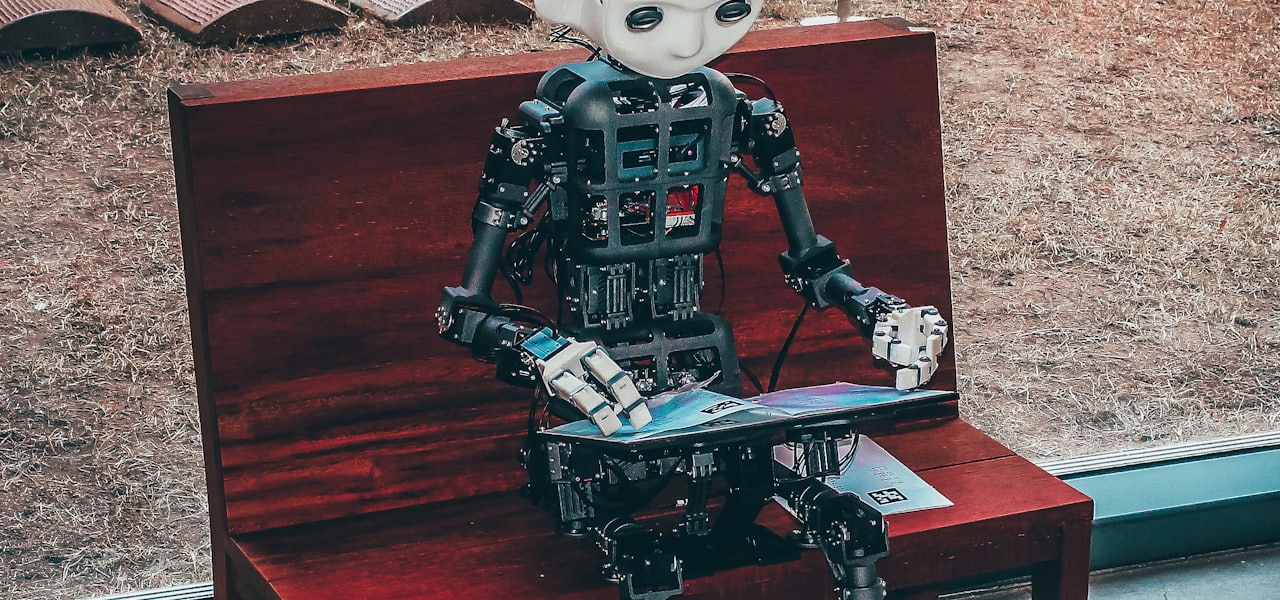
Developmental robotics (DevRob), sometimes called epigenetic robotics, is a scientific field which aims at studying the developmental mechanisms, architectures and constraints that allow lifelong and open-ended learning of new skills and new knowledge in embodied machines. As in human children, learning is expected to be cumulative and of progressively increasing complexity, and to result from self-exploration of the world in combination with social interaction. The typical methodological approach consists in starting from theories of human and animal development elaborated in fields such as developmental psychology, neuroscience, developmental and evolutionary biology, and linguistics, then to formalize and implement them in robots, sometimes exploring extensions or variants of them. The experimentation of those models in robots allows researchers to confront them with reality, and as a consequence, developmental robotics also provides feedback and novel hypotheses on theories of human and animal development. Developmental robotics is related to but differs from evolutionary robotics (ER). ER uses populations of robots that evolve over time, whereas DevRob is interested in how the organization of a single robot's control system develops through experience, over time. DevRob is also related to work done in the domains of robotics and artificial life. == Background == Can a robot learn like a child? Can it learn a variety of new skills and new knowledge unspecified at design time and in a partially unknown and changing environment? How can it discover its body and its relationships with the physical and social environment? How can its cognitive capacities continuously develop without the intervention of an engineer once it is "out of the factory"? What can it learn through natural social interactions with humans? These are the questions at the center of developmental robotics. Alan Turing, as well as a number of other pioneers of cybernetics, already formulated those questions and the general approach in 1950, but it is only since the end of the 20th century that they began to be investigated systematically. Because the concept of adaptive intelligent machines is central to developmental robotics, it has relationships with fields such as artificial intelligence, machine learning, cognitive robotics or computational neuroscience. Yet, while it may reuse some of the techniques elaborated in these fields, it differs from them from many perspectives. It differs from classical artificial intelligence because it does not assume the capability of advanced symbolic reasoning and focuses on embodied and situated sensorimotor and social skills rather than on abstract symbolic problems. It differs from cognitive robotics because it focuses on the processes that allow the formation of cognitive capabilities rather than these capabilities themselves. It differs from computational neuroscience because it focuses on functional modeling of integrated architectures of development and learning. More generally, developmental robotics is uniquely characterized by the following three features: It targets task-independent architectures and learning mechanisms, i.e. the machine/robot has to be able to learn new tasks that are unknown by the engineer; It emphasizes open-ended development and lifelong learning, i.e. the capacity of an organism to acquire continuously novel skills. This should not be understood as a capacity for learning "anything" or even “everything”, but just that the set of skills that is acquired can be infinitely extended at least in some (not all) directions; The complexity of acquired knowledge and skills shall increase (and the increase be controlled) progressively. Developmental robotics emerged at the crossroads of several research communities including embodied artificial intelligence, enactive and dynamical systems cognitive science, connectionism. Starting from the essential idea that learning and development happen as the self-organized result of the dynamical interactions among brains, bodies and their physical and social environment, and trying to understand how this self-organization can be harnessed to provide task-independent lifelong learning of skills of increasing complexity, developmental robotics strongly interacts with fields such as developmental psychology, developmental and cognitive neuroscience, developmental biology (embryology), evolutionary biology, and cognitive linguistics. As many of the theories coming from these sciences are verbal and/or descriptive, this implies a crucial formalization and computational modeling activity in developmental robotics. These computational models are then not only used as ways to explore how to build more versatile and adaptive machines but also as a way to evaluate their coherence and possibly explore alternative explanations for understanding biological development. == Research directions == === Skill domains === Due to the general approach and methodology, developmental robotics projects typically focus on having robots develop the same types of skills as human infants. A first category that is important being investigated is the acquisition of sensorimotor skills. These include the discovery of one's own body, including its structure and dynamics such as hand-eye coordination, locomotion, and interaction with objects as well as tool use, with a particular focus on the discovery and learning of affordances. A second category of skills targeted by developmental robots are social and linguistic skills: the acquisition of simple social behavioural games such as turn-taking, coordinated interaction, lexicons, syntax and grammar, and the grounding of these linguistic skills into sensorimotor skills (sometimes referred as symbol grounding). In parallel, the acquisition of associated cognitive skills are being investigated such as the emergence of the self/non-self distinction, the development of attentional capabilities, of categorization systems and higher-level representations of affordances or social constructs, of the emergence of values, empathy, or theories of mind. === Mechanisms and constraints === The sensorimotor and social spaces in which humans and robot live are so large and complex that only a small part of potentially learnable skills can actually be explored and learnt within a life-time. Thus, mechanisms and constraints are necessary to guide developmental organisms in their development and control of the growth of complexity. There are several important families of these guiding mechanisms and constraints which are studied in developmental robotics, all inspired by human development: Motivational systems, generating internal reward signals that drive exploration and learning, which can be of two main types: extrinsic motivations push robots/organisms to maintain basic specific internal properties such as food and water level, physical integrity, or light (e.g. in phototropic systems); intrinsic motivations push robot to search for novelty, challenge, compression or learning progress per se, thus generating what is sometimes called curiosity-driven learning and exploration, or alternatively active learning and exploration; Social guidance: as humans learn a lot by interacting with their peers, developmental robotics investigates mechanisms that can allow robots to participate to human-like social interaction. By perceiving and interpreting social cues, this may allow robots both to learn from humans (through diverse means such as imitation, emulation, stimulus enhancement, demonstration, etc. ...) and to trigger natural human pedagogy. Thus, social acceptance of developmental robots is also investigated; Statistical inference biases and cumulative knowledge/skill reuse: biases characterizing both representations/encodings and inference mechanisms can typically allow considerable improvement of the efficiency of learning and are thus studied. Related to this, mechanisms allowing to infer new knowledge and acquire new skills by reusing previously learnt structures is also an essential field of study; The properties of embodiment, including geometry, materials, or innate motor primitives/synergies often encoded as dynamical systems, can considerably simplify the acquisition of sensorimotor or social skills, and is sometimes referred as morphological computation. The interaction of these constraints with other constraints is an important axis of investigation; Maturational constraints: In human infants, both the body and the neural system grow progressively, rather than being full-fledged already at birth. This implies, for example, that new degrees of freedom, as well as increases of the volume and resolution of available sensorimotor signals, may appear as learning and development unfold. Transposing these mechanisms in developmental robots, and understanding how it may hinder or on the contrary ease the acquisition of novel complex skills is a central questi
Spanner (database)
Spanner is a distributed SQL database management and storage service developed by Google. It provides features such as global transactions, strongly consistent reads, and automatic multi-site replication and failover. Spanner is used in Google F1, the database for its advertising business Google Ads, as well as Gmail and Google Photos. == Features == Spanner stores large amounts of mutable structured data. Spanner allows users to perform arbitrary queries using SQL with relational data while maintaining strong consistency and high availability for that data with synchronous replication. Key features of Spanner: Transactions can be applied across rows, columns, tables, and databases within a Spanner universe. Clients can control the replication and placement of data using automatic multi-site replication and failover. Replication is synchronous and strongly consistent. Reads are strongly consistent and data is versioned to allow for stale reads: clients can read previous versions of data, subject to garbage collection windows. Supports a native SQL interface for reading and writing data. Support for Graph Query Language == History == Spanner was first described in 2012 for internal Google data centers. Spanner's SQL capability was added in 2017 and documented in a SIGMOD 2017 paper. It became available as part of Google Cloud Platform in 2017, under the name "Cloud Spanner". == Architecture == Spanner uses the Paxos algorithm as part of its operation to shard (partition) data across up to hundreds of servers. It makes heavy use of hardware-assisted clock synchronization using GPS clocks and atomic clocks to ensure global consistency. TrueTime is the brand name for Google's distributed cloud infrastructure, which provides Spanner with the ability to generate monotonically increasing timestamps in data centers around the world. Google's F1 SQL database management system (DBMS) is built on top of Spanner, replacing Google's custom MySQL variant.